
Finding the Deeper Sky (2026)
Book 3 is done.
Finding the Story
This is the first story that really started from an explicitly personal space. I was hanging out with my son at the bookstore a lot and I decided to try to write a story that he might want to read. He’s loved dinosaurs since he was very little, and I thought there weren’t enough stories (outside of Jurassic Park) that incorporated dinosaurs. How could one do it in a different way? He loves playing video games with his friends, and I thought that provided a nice foundation for a new story. I can’t exactly remember why the setting moved to Hawaii, but now it feels inevitable. The characters feel so real to me, the innumerable decisions along the way feel destined.
I wanted this to be a story of three friends saying goodbye to a friend who would be leaving town because of his parents’ divorce. So, it was a story of ego demolition and grief. And then acceptance, and rebirth. That was the vision anyway. I made explicit plans to end chapters with cliffhangers so that the reading experience felt exciting. I wanted each friend’s level to feel personal and organically incorporated into the overall tale of the novel. I didn’t want either of the parents to be demonized or blamed.
This age group (i.e. middle grade) really makes me think of Steven Spielberg more than it makes me think of Wilson Rawls or Madeleine L'Engle or Gary Paulsen or Lynne Reid Banks, though those authors meant (and mean) a lot to me. So it seemed like a perfectly natural setup for a coming-of-age adventure tale for these three boys. Spielberg has often used divorce as a backdrop or emotional foundation for his coming-of-age stories, and that makes sense, because it affects so many people, and yet remains emotionally unique.
As I was putting the story together, I realized that I put myself into another fantastical situation, where I was trying to combine three different perspectives on world-building into one larger world-building structure, so there would be a lot to keep track of. It sounds like a good idea when you hear it (and it is). It sounds fun! But actually doing it is much harder than you might imagine.
I’m pleased with how it turned out. It’s 27 total chapters, a little over 220 pages. It’s an action-packed story about friendship, wonder, grief, and belonging, and it incorporates video game mechanics throughout in an organic way. It took a lot of work to get the story onto the page. It took more work on top of all that to edit it and fit it into shape. I also decided to included images with each chapter of this story. I devised a linocut design via Midjourney that I will include at the start of each chapter as a visual anchor.
The first three chapters are below.
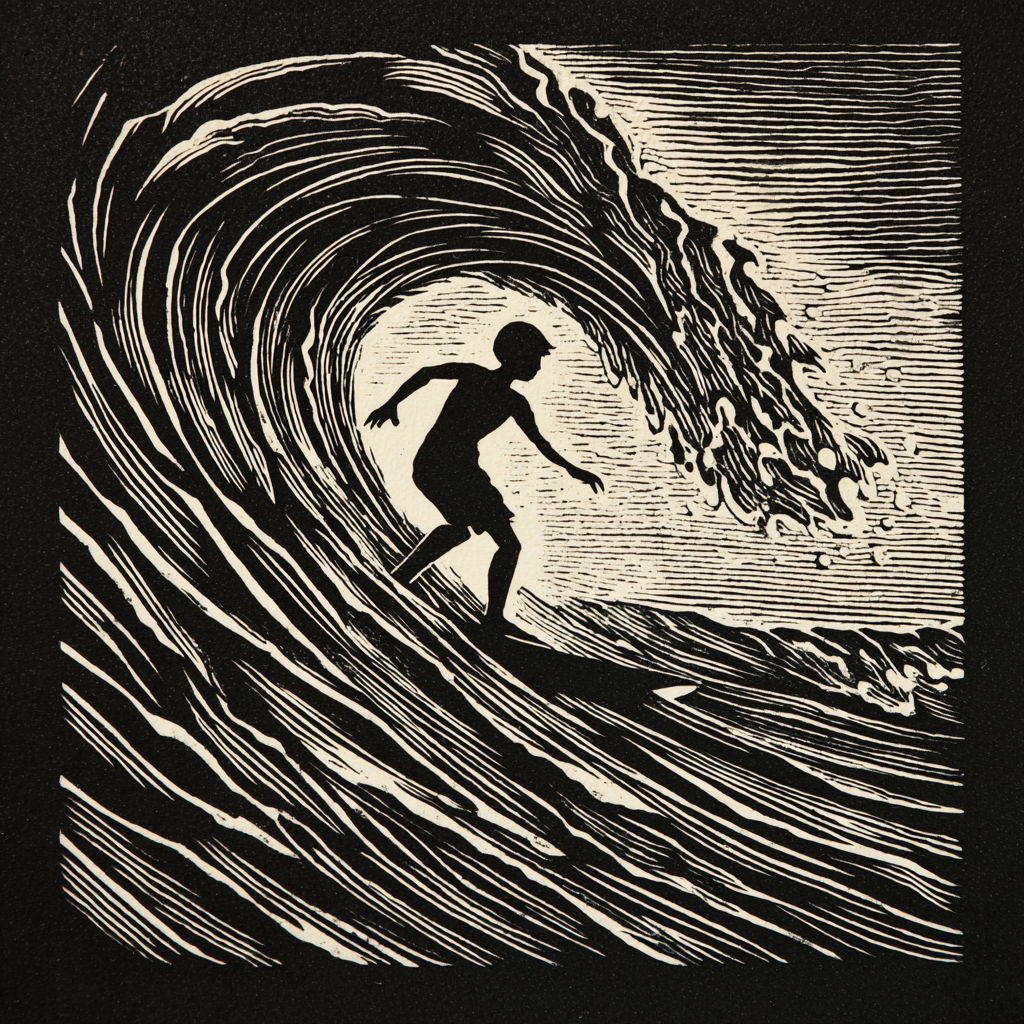
Chapter 1: The Ticking Clock
The wave lifted the board from underneath, and for one suspended second Koa was weightless, the salt spray in his teeth, the wind in his hair.
Then the lip threw him and the ocean swallowed him whole. He tumbled and couldn’t tell up from down. But then he let his body go loose the way his father had taught him, be the water, not the fight, and after a few moments the turbulence spat him out in the shallows, his board leash taut against his ankle, his cheek pressed against the wet sand.
He lay there and breathed. Above him the early morning O’ahu sky burned off its pinks and reds, and the blue came through so clean and deep it looked manufactured. A frigate bird crossed it in a long, lazy arc. Somewhere down the beach a dog was barking at something it would never catch.
Seventy-two hours. The thought arrived like a finger pressing a bruise. Seventy-two hours and the island would be something he remembered instead of something he stood on. Seventy-two hours and this water would be a thousand miles behind him.
He pushed himself up and sat in the shallows. The water moved around his waist in small, rhythmic pulses. The reef was maybe thirty yards out, dark beneath the surface, and beyond it the open ocean went all the way to the horizon and then kept going. Seattle was out there somewhere. Past the horizon. Past everything. He didn't want to think about Seattle.
——————————————————
The board was a beat-up seven-two his father had shaped for him two summers ago in the garage on a Saturday afternoon that Koa still thought about sometimes.
He could still smell the resin and sawdust and hear the radio playing something old and slack-key. He pictured his dad's hands moving over the foam with a patience that seemed to come from somewhere deep and practiced. His dad had written something small on the bottom rail in permanent marker, hidden under the fiberglass. No wipe out lasts forever. Koa had read it so many times that the words stopped being words and became a philosophy, a way to live. He needed it right now.
He paddled back out. The morning was still early enough that he had the break mostly to himself. One older uncle was working the outside set, smooth and unhurried, dropping into waves with the kind of ease that takes decades to earn. He didn't acknowledge Koa and Koa didn't acknowledge him. That was the understood language of early mornings. You shared the water and left each other alone inside it.
Koa sat up on his board and let the swells move under him. You could see the curve of the bay from out on the water: the fringe of coconut palms, the red dirt road that ran behind the beach, the roofline of the Nakoa house three lots back from the water where Mako had lived his entire life and would keep living after Monday. The Ko'olau range behind it all, green going darker green going into cloud. There was a smell to the morning air out on the water that Koa had never been able to describe to anyone's satisfaction. Salt was part of it. Plumeria from somewhere. Red dirt after the previous night's rain. Something older underneath all of that.
He breathed it in slowly, like he was trying to memorize the inside of his own lungs.
——————————————————
His mother had started the boxes three days earlier.
That was the thing he kept returning to. The argument from last night was nothing new. It was just the same fraying at the edges that had been happening for two years, the quiet dinners and the closed doors and the careful way his parents moved around each other like they were both carrying something fragile. He had learned to read that silence the way he read the water. Watching for signs and adjusting.
No. It was the boxes that had done something to him. He had come home from school on Wednesday and there they were, stacked flat against the living room wall. Brown cardboard. A black marker sitting on top. His mother stood in the kitchen doorway with a mug of coffee, watching him take it in.
We should start with your room, she had said. Just the things you really want to bring.
He nodded and went to his room and sat on the edge of his bed for forty minutes without touching anything. The boxes were still flat against the wall this morning when he left. He hadn't unfolded a single one. He told himself that was because he hadn't decided what to bring yet.
——————————————————
A set appeared on the horizon. Three waves, maybe four, moving in clean and organized.
Koa turned the board, read the first wave's approach, and paddled. He felt the gathering momentum and the ocean lifting him from underneath. There was always the split-second calculation of whether you had it or you didn't, and then he was up, his weight shifting forward, the board finding the line, and for a few seconds there was nothing in the world except the wave and the speed and the spray and the absolute animal fact of being exactly where he was supposed to be. He rode it almost to the sand and then he stood in the shallows again, his chest heaving, grinning despite everything.
See, he told himself. You can still do this in Seattle. There were waves near Seattle, somewhere, technically, if you drove to the coast and wanted cold gray Pacific surf on a cold gray beach. He had looked it up. He had read the descriptions of the breaks and they had sounded fine, probably, for someone who hadn't grown up in Oʻahu and didn't know what water was supposed to feel like. For someone who didn't have his father's handwriting on the bottom of his board.
——————————————————
He caught two more waves and then sat on his board in the lineup and let the morning move around him.
The pink was completely gone from the sky now. The blue was full and deep and the sun was climbing and the uncle was paddling in, and soon the families would start arriving with their coolers and their beach chairs and their kids who would run into the shallows shrieking. Seventy-two hours to Monday.
His dad hadn't cried. That was somehow the worst part. When his mom had sat Koa down four months ago and explained about Seattle, about the opportunity, about the schools and the future and all the things the island couldn't give him, his dad had been there too, quiet in the corner chair. When Koa had looked over at him expecting something, anything, his dad had just nodded slowly and looked at his own hands.
It's a good chance for you, his dad had said. Good chances are worth hard things.
Koa had wanted to throw something. He didn't blame his mom. He knew he didn't, underneath the anger, underneath the tightness in his chest every time he looked at those flat cardboard boxes. His mom wasn't a villain. She was just a person who needed something the island couldn't give her anymore, and maybe she was right about Seattle, which was the part that was hardest to think about. Maybe the opportunities were real and the schools were better and the future was bigger and all the painful logic of the decision actually added up the way she said it did. But that didn't make it hurt less.
He lay back on his board and stared straight up at the sky. The blue was enormous. That was the thing about Oʻahu sky that you forgot until you were flat on your back looking directly into it, how deep it went. Like the atmosphere was something you could fall into if the world suddenly flipped over. He stared into it.
And then the sky cracked open.
It lasted less than a second. One moment it was blue, familiar, the ordinary morning sky above an ordinary morning, and then something shifted, some quality of the light or the depth or the angle, and the blue was gone, replaced by something that made no sense, a swirling vortex of cosmic fire, oranges and deep indigos spinning around a dark center, massive and ancient and close, so close he felt the heat of it on his face, felt a low vibration ringing in his bones.
He jerked upright on the board.
A frigate bird crossed the sky in a long, lazy arc. Down the beach the dog was still barking. The uncle's truck was pulling out of the parking lot, tailgate rusted, a single surfboard sticking out the back. Koa sat very still and pressed one hand flat against his chest. The vibration was gone. The heat was gone. The vortex was gone as completely as if it had never been there at all.
He looked at the sky and then he picked up his board and walked out of the water.
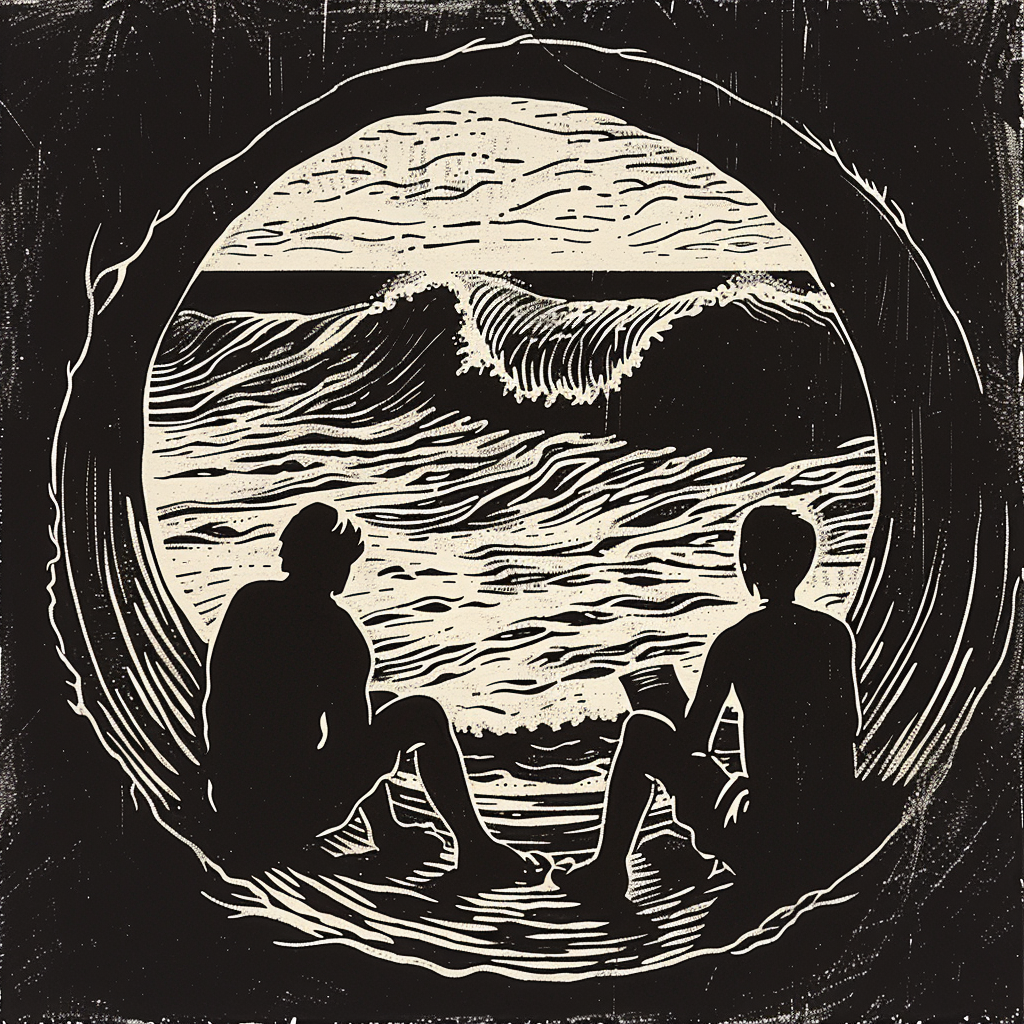
Chapter 2: The Dreamers
The concrete drainage pipe ran under the coast road about a quarter mile north of the beach.
It was wide enough to walk through if you ducked, and it emptied out onto a flat shelf of rock above the waterline where the tide pools were. Nobody else seemed to use it and Koa never understood why. The pipe was dry most of the year, the rock shelf was shaded in the afternoon, and from the right angle you could see all the way down the coast to where the reef bent outward and the water turned from green to deep blue in a clean, sudden line.
They had been meeting here since sixth grade. Koa came from the beach end, still damp from the morning session, his board tucked under his arm. He heard Mako's voice first, precise and slightly too loud the way it got when he was explaining something he cared about, and then Boz's laugh, the big rolling one that meant Mako had said something unintentionally funny and didn't realize it yet.
Koa ducked through the pipe. Mako was sitting cross-legged on a nearby rock with his battered field notebook open across his knees, his pen moving. Boz was lying on his back with his forearm over his eyes and his feet hanging off the edge above the tide pools, like falling was something that happened to other people.
"He lives," Boz said, without moving his arm.
"Barely," Koa said. He set his board against the pipe and dropped down onto a rock nearby. It was warm from the morning sun. "Wave caught me wrong on the first one."
"I heard the wipeout from my house," Mako said, not looking up from his notebook.
"You can't hear the beach from your house," Koa said.
"Today I could."
Boz’s hair was still dry, which meant he hadn't been in the water yet, which meant he had probably been here for a while doing nothing in particular. Boz had a talent for stillness that contradicted everything else about him. He could lie in a concrete pipe for an hour without his body seeming to notice or object.
Boz moved his arm and squinted over at Koa. "You eat?"
"No."
Boz reached into the pocket of his board shorts and produced a slightly flattened granola bar, which he threw at Koa's chest without sitting up. Koa caught it.
"Last one," Boz said. "You're welcome."
"You've been here since sunrise?"
"The pipe was calling me."
Mako looked up from his notebook. "The pipe does not call people, Boz."
"That's what the pipe wants you to think."
——————————————————
Koa ate the granola bar and looked out at the water.
The morning had fully arrived now. The deep blue had settled and the swells were coming in at clean intervals. A light trade wind pushed small whitecaps across the surface further out. Two paddleboarders were working their way down the coast in long, even strokes. A container ship sat on the horizon, motionless from this distance, though Koa knew it was moving constantly, that everything on the horizon was always moving even when it looked like it was standing still.
"Your mom start the boxes yet?" Mako asked.
There it was. Koa had been waiting for it, had known it was coming since he ducked through the pipe, because that was the thing about these two. They never pretended the hard things weren't there. It was one of his favorite things about them.
"Three days ago," Koa said.
Mako closed his notebook. He set it on the rock beside him and looked at Koa with the careful, measuring look he used when he was trying to decide how much to say.
"Have you packed anything?" Mako asked.
"No."
"Koa."
"I know."
"The flight is Monday."
"I know, Mako."
Mako picked up his notebook again and Koa looked back at the water.
——————————————————
"I need to tell you something," Koa said.
He hadn't planned to say it yet. He had spent the whole walk from the beach deciding not to say it, running through the reasons it sounded crazy, imagining the ways Boz in particular would respond to it. And then he had opened his mouth and said it anyway, because seventy-two hours was not a lot of time to keep things to yourself.
Boz moved his arm off his eyes again. Mako went very still.
"This morning," Koa said. "In the water. I was lying on my board and I looked up at the sky and something—" He stopped. Then he tried again. "The sky opened. I don't know how else to say it. Like a crack in it. And through the crack there was this—" He looked at his hands. "It was like fire but cosmic. Like the inside of a star. These colors, orange and blue, all spinning around a center point. And there was a strange sound."
He looked up.
Boz was sitting up now. His feet were no longer hanging over the tide pools. He looked at Koa with an unfamiliar expression. Mako had not moved at all. His notebook was in his lap and his pen was in his hand and he looked like someone had pressed pause on him.
"How long did it last?" Mako said. His voice was careful in a way that made Koa's skin prickle.
"Less than a second. Maybe less than that. And then it was just sky again." Koa looked between them. "I know how it sounds."
"When did it happen?" Boz said.
"This morning. Maybe seven, seven-thirty. I was in the lineup, lying on my board—"
"Koa." Boz's voice had gone quiet in a way that was deeply unfamiliar. Boz's voice was not a quiet instrument. "What time exactly."
"I don't know exactly. Seven-fifteen, maybe. Why?"
Boz looked at Mako and Mako looked back. The trade wind moved through the space between them. Below the rock shelf a wave came in and turned itself over in the tide pools and pulled back out.
"Boz," Koa said.
"Seven-nineteen," Boz said. "I know because I checked my phone right after because I thought I was still asleep." He exhaled slowly. "I was in my backyard. I was waxing my board. And the sky—"
"Opened," Mako said gently.
They both looked at him.
Mako was looking out at the water now, not at either of them. His jaw was tight and his pen was very still.
"I was at my desk," he said. "Working on the level. Seven-nineteen, or close enough that it doesn't matter. The sound was strange."
"Yeah," Koa said.
"Like a tuning fork."
"Is that what that is?"
Mako was quiet for a moment.
"I've been trying to code a sound like that for three weeks," he said. "I don't know how to make it because I don't know what it is. And this morning it just appeared."
"In the sky," Boz said.
"Yeah," Mako confirmed. “In the sky.”
They sat together in silence. Below them a hermit crab dragged a borrowed shell across the rock basin floor. A small goby sat motionless against the floor of a tide pool and then vanished in a single sideways flicker, gone so fast it might not have been there at all. Koa picked at the white crust of dried salt on the rock he was sitting on.
"Okay," Boz said finally. He lay back down on the pipe and put his forearm over his eyes again. His voice was almost normal. "So that's a thing that happened."
"That is definitely a thing that happened," Koa said.
——————————————————
They stayed on the rock until the paddleboarders had long since disappeared down the coast and the sun had climbed high enough to kill the shade. Mako filled four pages in his notebook. Boz stared at the sky cautiously, in the way of someone who has recently learned that the sky might stare back. They talked about it.
"It looked like the Pillars of Creation," Mako said. "The Webb image. The infrared one."
Boz squinted. "The what?"
"Stellar nursery. The Eagle Nebula, where stars are born." He said it like it was obvious. "I have it as my lock screen."
"You have a nebula on your phone?"
"It's the highest-resolution image of active star formation ever captured. It’s beautiful."
Boz looked at Koa. "That's cool," he said.
Koa didn't mention the way it had felt like something vast and ancient and very close had briefly noticed him. He wasn't sure why he held that part back. What he said instead was: "We have seventy-two hours before I have to leave."
Boz took his arm off his eyes. Mako stopped writing.
"I say we spend that time together, this weekend at Mako's. If it happens again, at least we get to experience it together." He looked at them both. "Yeah?"
Boz sat up slowly. He looked at Koa with those easy, sun-squinted eyes that very rarely showed you what was behind them. Then he held out his fist. Koa bumped it.
Mako closed his notebook with a decisive snap. "I’ve got the house to myself this weekend," he said. “So it’s good timing.”
“We’ve got the house to ourselves, Mako,” Boz corrected.
“That’s what I meant,” Mako said. “Ourselves. We can get some pizza. You guys can check out my gaming setup and there’s plenty of room to sleep on the couches, like usual, but we don’t have to worry about when we get up, because my parents are gone, my sister is gone.” Mako kept talking. Boz and Koa looked at each other and smiled.
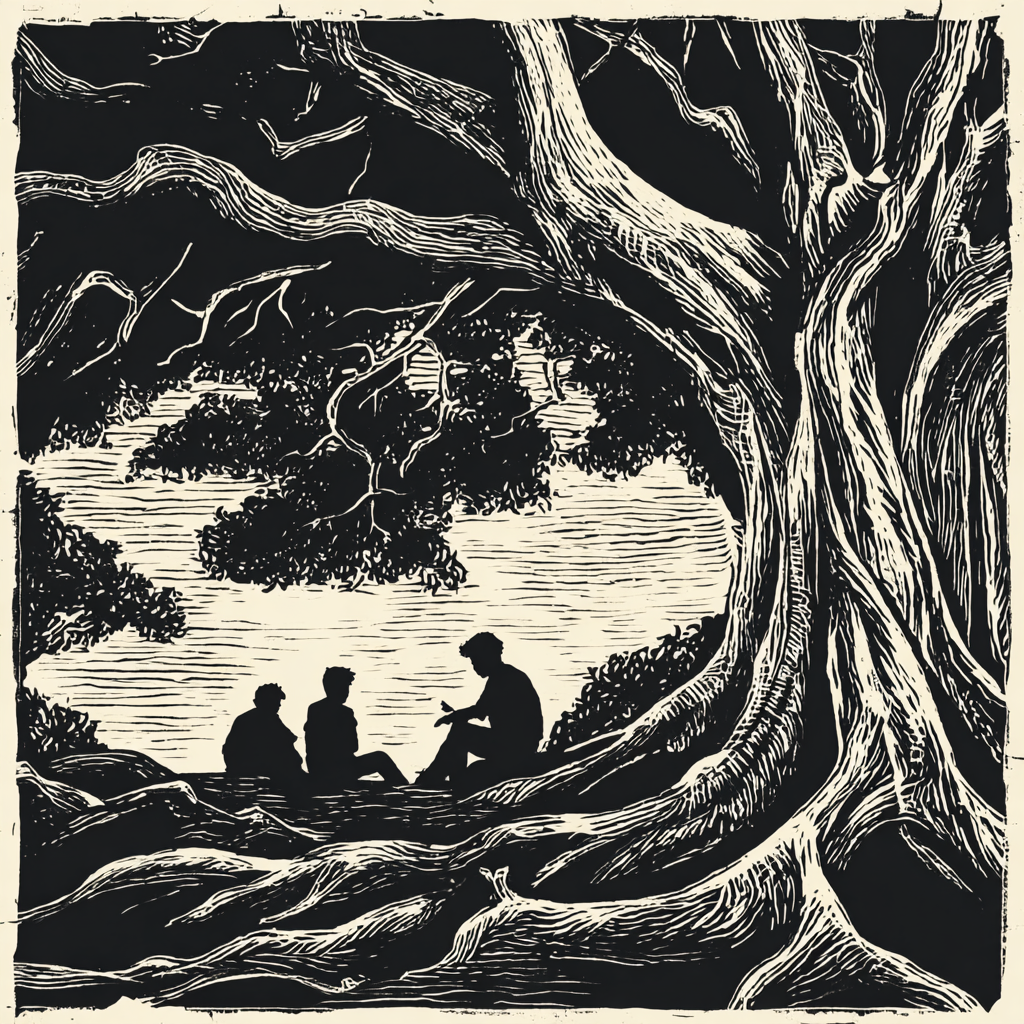
Chapter 3: The Blueprint
They had moved from the rock shelf to the shade of a monkeypod tree at the edge of the coast road.
The three of them spread out in the roots with their backs against the trunk, passing a water bottle between them. The afternoon had come on fully now, the trade wind dying back, the air thickening with the humid weight that settled over the windward coast on clear afternoons like a warm, breathing blanket.
Koa had been drawing in the dirt with a stick. Just lines, shapes, the automatic doodling of a restless hand. He hadn't realized what he was drawing until Mako said something.
"That's the mangrove channel," Mako said. "The one behind your dad's house."
Koa looked down at the dirt. It was the mangrove channel. The strange bend of it, the way it narrowed before opening into the tidal flat. He had drawn it without thinking, the way you might hum a song you didn't know you knew.
"I've been building it," Koa said.
Boz and Mako both looked at him.
"Building what?" Boz said.
"A level." Koa kept his eyes on the dirt drawing. "In the engine we used for that project last year. I've been — I don't know. I started it a few weeks ago. I was trying to — " He stopped and turned the stick over in his hands. "It sounds stupid."
"It doesn't sound stupid," Mako said.
"I was trying to save it," Koa said. "The channel. The swamp. All of it. Like if I could build it real enough then it would be there." He shook his head. "I don't know what I thought. That it would still exist somewhere for me even after I left."
Nobody said anything. The trade wind moved through the monkeypod leaves above them in a long, soft rush.
"The Bismuth level is mine," Mako said.
Koa looked up. Mako was looking straight ahead at the road, his notebook closed in his lap, his expression carefully neutral.
"I've been building it for six weeks," Mako continued. "Since before the vision. I started it before I knew what it was supposed to be." He paused. "I saw this documentary on sea turtles. They have this sixth sense that allows them to navigate using the Earth's magnetic field. It helps them figure out where they're going. It gave me ideas for the game I was building. I thought I was just experimenting with mineral-biology systems. Organisms that process energy through magnetic resonance instead of digestion. Creatures that communicate in frequencies rather than sound." A beat. "I have forty-one failed attempts at coding that tuning-fork resonance alone."
"Like the one from this morning?" Koa said.
"Yeah," Mako confirmed. "That's why it was super eerie to me. I have been trying to synthesize it for six weeks. I can't do it. Apparently it just exists and can't be captured, because I haven't been able to do it."
Boz was quiet. Koa and Mako both looked at him. He was leaning back against the monkeypod root with his arms crossed, deciding upon something.
"Boz?" Koa said.
"I created a level made out of fire," Boz said. "Like the vortex in the sky." He said it simply, without decoration, the way he might have said mine's the blue board, the one by the gate. "Just — floating rocks and lava and stuff. It's pretty crazy." He picked up a pebble and turned it over in his fingers once and set it back down. "It's probably terrible compared to yours."
"Have you been building it long?" Mako asked.
Boz shrugged. "A while."
Which meant yes, Koa thought. Which meant long enough that he was slightly embarrassed about it.
——————————————————
It was Koa who said it first, though he understood immediately from the way the other two responded that they had both been thinking it.
"We should put our levels together. Blind," he said. "Without looking at them first. Just compile them and see what happens." He felt the idea taking shape as he said it. "This weekend. At your place, Mako. Final send-off."
"A send-off," Mako said carefully.
"That's not what it is," Boz said, with surprising firmness.
Koa looked at him.
"It's not a goodbye," Boz said. "We're just building something together. The three of us. One last build." He picked up the pebble again and this time threw it lightly into the road. "That's all it is."
Koa held his gaze for a moment.
"That's all it is," Koa agreed.
Mako looked between them. Then he opened his notebook.
"The stitching will be technically complicated," he said. "Three separate engines, three different design philosophies, compiled blind with no shared architecture." He was already writing. "The transition logic alone will be—"
"Mako," Boz said.
"Interesting," Mako finished, with the smallest possible smile. "I was going to say interesting."
——————————————————
Koa left them in the late afternoon.
Mako was still writing. Boz was lying back in the monkeypod roots watching the sky. Koa walked the long way home along the coast road, board under his arm, feeling the day's heat radiate up from the asphalt. The light was going golden and low, the kind of late afternoon light that made everything on the windward coast look like a memory even while you were standing in it.
He thought about his level. The mangrove channel, the tidal flat, the distinct green-black of the water in the deep parts where the roots thickened. He had built it from instinct and from love and from a kind of desperate preservation instinct he hadn't wanted to examine too closely. It was the most personal thing he had ever made. Showing it to anyone, even Boz and Mako, felt like handing over some insecure part of himself that could be easily broken.
He thought about what Mako had said. Six weeks. Forty-one attempts at a sound. Building something he didn't have a name for yet, the way you sometimes obsessed over something or someone before you understood why. He was so deep in thought that he was halfway up his front path before he heard the laughter.
——————————————————
His mother's real laugh was not something she shared casually.
There was the polite laugh, the social one, the laugh she used in work situations and at neighborhood gatherings. It was pleasant and polite. Koa had grown up understanding the difference between that one and the real one. They sounded similar from a distance, but they were not the same thing at all. The real laugh was bigger and less careful and it came from some true place inside her. He had not heard it in a long time. He hadn't realized until this moment, standing on the front path with his board under his arm, how long it had actually been.
Her laugh came through the kitchen window, tender and unguarded, accompanied by the smell of garlic and sesame oil and the sweetness of the teriyaki glaze she made from scratch, the one that took forty minutes and that she only made when she wanted to do something loving and couldn't find another way to say it.
Shoyu chicken. His favorite meal since he was seven years old. He stood on the path and breathed in the smell, the laugh, the golden light on the front of the house, and he felt an odd sense of anger and sadness about these things that he loved.
——————————————————
She was at the counter with her back to him when he went inside.
Her phone was tucked between her ear and her shoulder, both hands working the glaze. She was wearing the old university sweatshirt she cooked in, the gray one with the cracked letters, and her hair was up. She hadn't heard him come in.
"—I honestly don't know yet," she was saying, into the phone, still laughing a little at whatever had just been said. "There's so much to figure out still, the apartment and Koa's school and just—" A pause, listening. Another laugh, quieter this time, more tired. "Yeah. Yeah, I know. One thing at a time."
Koa calmly set his board against the wall. He had overheard a different conversation three weeks ago, standing in this same hallway, not breathing, listening to her talk to someone about her maiden name. Whether she'd go back to it. How she wasn't sure. The specific careful way she'd said Lau, his name, his father's name, like she was measuring the weight of it. He had stood there until he couldn't stand there anymore and then he had gone to his room and closed the door without making a sound.
He walked into the kitchen. She heard him and turned, phone still at her ear, and her face shared the complicated expression he didn't want to look at too closely, the love and the guilt and the exhaustion all present simultaneously. She held up one finger. One minute. He nodded and opened the refrigerator and stood in the cold air looking at nothing.
The refrigerator was reorganized. The shelves were different. She had moved things around, consolidated, made space. Efficient and practical. The logical behavior of someone preparing to pack up a household. His leftover rice from two days ago was gone.
It was leftover rice. He knew it was leftover rice. He knew with the full rational thought of his fourteen-year-old brain that leftover rice was not a thing worth feeling anything about, that she had almost certainly thrown it away because it was old, that this was a completely normal and reasonable thing to do. He closed the refrigerator.
She was finishing the call. "I'll talk to you later. Yeah. Bye." She set the phone on the counter and turned to him with a careful, warm smile. "Good timing. Twenty minutes."
"You moved my rice," Koa said. The words came out flat and strange in the warm kitchen air.
Ashley looked at him. The careful smile was still present, but it was recalibrating. "It was from Tuesday, baby. It had been in there—"
"You didn't ask me."
"Koa—"
"You just moved it." He could hear himself. He could hear exactly how it sounded and he could not stop. "You just decided, like you just decided about Seattle. Like you just decide everything and the rest of us are supposed to—"
"That is not fair," she said softly.
"None of it's fair."
The kitchen was very still. The glaze was still on the heat and starting to catch and neither of them moved to take it off. The smell of it filled the room, sweet and slightly sharp, his favorite meal going wrong at the edges.
Ashley reached over and turned off the burner. She did it slowly, deliberately, in the manner of someone choosing not to respond to what she most wanted to respond to. When she turned back her eyes were bright in a way he recognized and hated himself for causing.
"I know you're angry," she said.
"I'm not—"
"You are. And that's okay." Her voice was steady but thin. "I know why you're angry. I understand it. But I need you to hear me when I tell you that this decision—"
He didn't hear the rest of it. He was already picking up his board from the wall, already moving toward the door, the screen door banging behind him, the warm evening air hitting his face as he took the porch steps in one stride and kept moving, down the path and out the gate and onto the coast road without any particular destination in mind, just away, just forward, just the slap of his feet on the asphalt and his board under his arm and the golden light going orange going red on the water.
Behind him, through the kitchen window, the smell of shoyu chicken followed him half a block before the trade wind took it. He walked until it was gone.
