
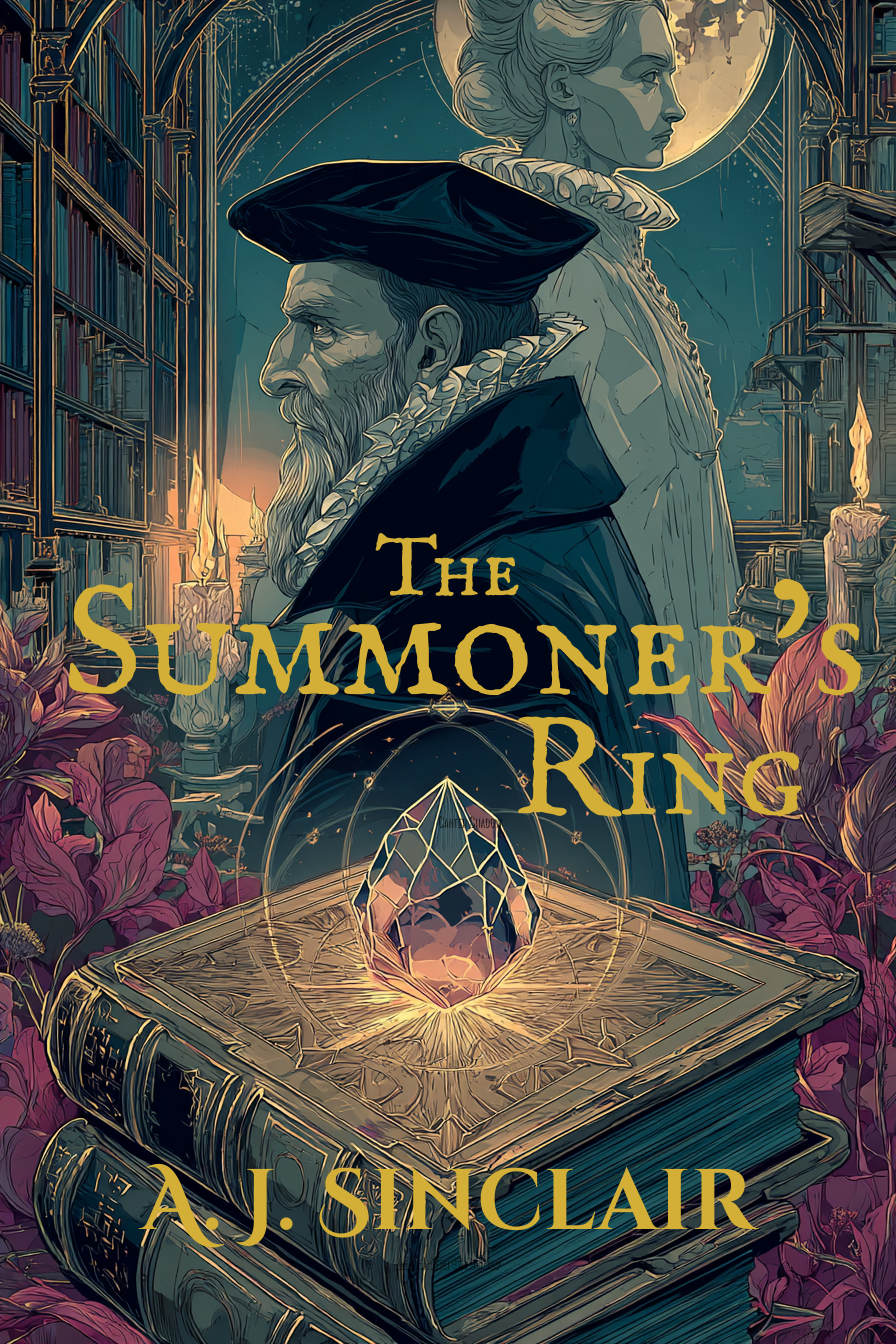
The Summoner’s Ring
London, 1583. John Dee is the most brilliant man in England and perhaps the most dangerous.
Royal astrologer. Mathematician. Spy. Now, guided by a scarred scryer and a black obsidian mirror, he believes he stands on the threshold of the greatest discovery in human history: direct communication with the Angels of God.
When a Polish count offers him a laboratory in Prague and the patronage of the Holy Roman Emperor, Dee leaves his extraordinary library at Mortlake and travels east towards transcendence.
What he finds in Prague will change everything. The angels speak. The sessions deepen. And someone travels to the other side.
The Summoner's Ring is a breathtaking historical novel about genius, obsession, and the thin line between revelation and ruin.
Finding the Story
I learned about John Dee, Edward Kelley, and Giordano Bruno while reading the book The Philosopher’s Secret Fire: A History of the Imagination by Patrick Harpur. I’d read his book Daimonic Reality and loved it, partly because of how many ideas it gave me and partly because of how profoundly it shifted my everyday interpretation of the world.
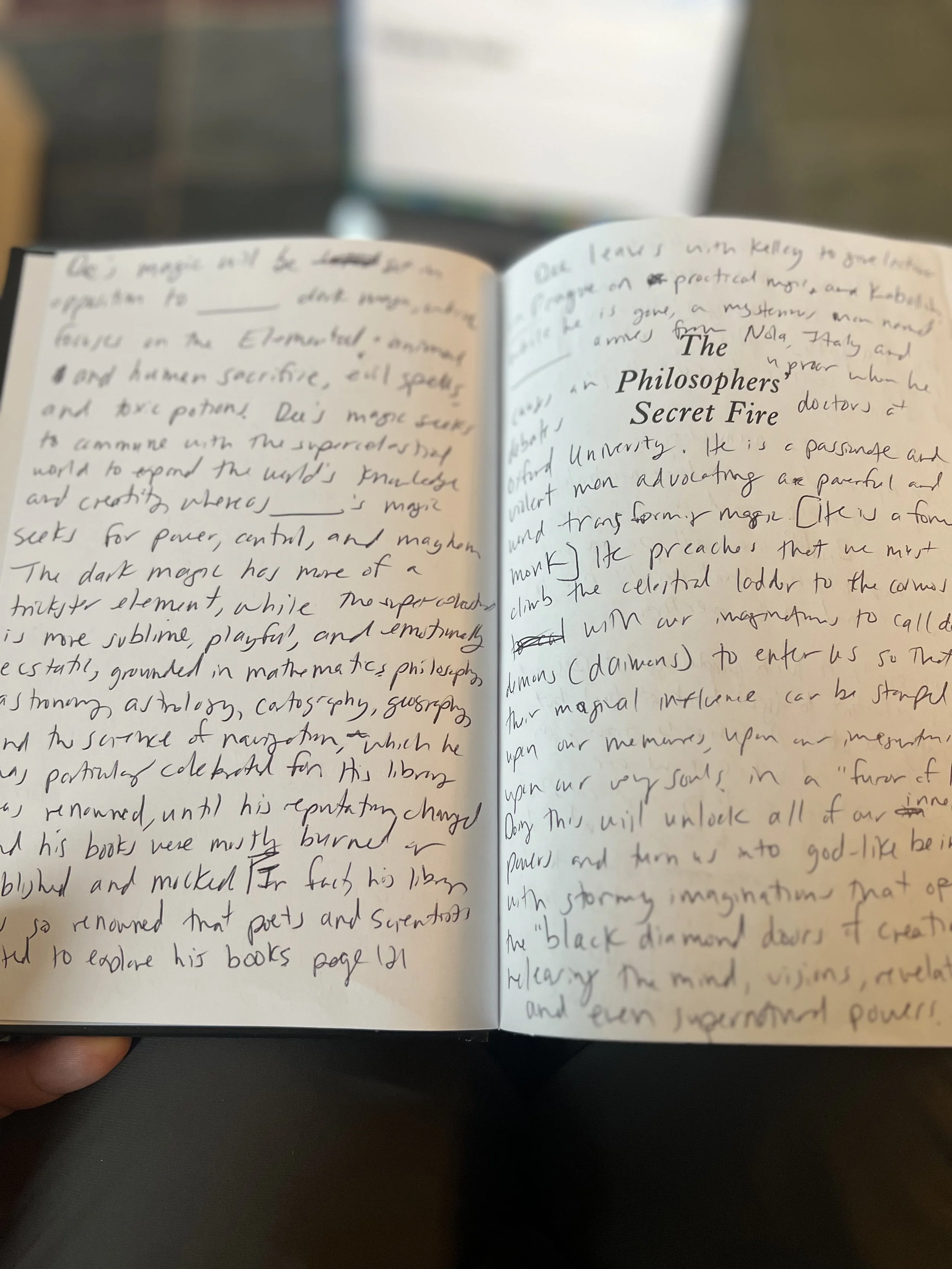
The Philosopher’s Secret Fire was no different. I was racing through it, but stopped after Chapter 15: Conjuring Angels, because I couldn’t get past the idea that these characters and this time period would make a fantastic historical novel or movie or limited TV series. Because I owned the book, I started drafting story ideas in the beginning of the book, using the available white pages. After I ran out of room there, I moved to Google Docs, and it was just a slight hop over to using Gemini to develop the ideas further, which is what I did.
Tech Stack
Claude Sonnet 4.6 for drafting and story planning
Gemini 3.1 (free) for brainstorming and story structuring
Midjourney V7 for book cover design
Canva for text design for book cover
Novelcrafter for writing organization
Google Docs for writing and story bible backups
Workflow
I use Gemini to do my initial brainstorming and story structuring. Then I take what I end up with from that and ask for Claude’s help. Once Claude feels ready to start drafting, it will let me know, and if I have no additional questions, I’ll tell it to draft the first chapter. When I receive a chapter draft, I will edit and assess it.
Once I have the chapter how I want it, I’ll copy and paste it into Google Docs (and Novelcrafter) as a backup. I’ll often be prompted with lingering questions about the next chapter. I answer (or ignore) those and bring up other ideas I might have. And then I say when I am ready to draft the next chapter, and I repeat that process until the book is finished.
I like creating sections in the book, because that gives me small goals to reach so that the overall goal of reaching the end doesn’t feel so far away. A three act structure works well, aiming for a book beween 250 and 350 pages. 30-36 chapters. For example, 3 acts with 12 chapters each at 8-10 pages per chapter is a good starting structure.
How Much Do You Re-Write?
Most of the re-writing is small, managing the structure of sentences and the flow of the chapter. When I attempt to intervene and add larger re-writes, it tends to produce a noticeable Frankenstein’s monster of tone. I think it’s easier to function as the primary writer with some AI input with planning, editing, and structuring, or, function more as an aggressive editor for the A.I.’s writing. One or the other.
Most of my writing assistance (or writing personality) comes through the planning, editing, and overall management of the project. I’ve come to view my role in this as being more like a Book Director or Story Manager, while also being the full-time editor.
Annoying Ticks as Tells
Sometimes I remove a lot of text, noticing the standard ticks and quirks of A.I. writing, which I plan to document in the Lab. But after working on this 8-12 hours a day for a month, this is my first impression — if a story is well-structured and the characters are given things to do and say and ways to grow, then the writing feels like it arrives in a more effortless, impressive, and, dare I say, inspired way.
The chapters where I am frustrated by the generic writing are often tells that something is wrong in the way the story has been planned and the characters (and their dynamics, internal and external) have been developed. I realize that the motivations need to be fleshed out. I try to be an active student of drama, using my experience with all kinds of storytelling (and my storytelling instincts), to push boundaries, enliven plots, and complicate characters. How do I ratchet up the tension? How do I make the reader want to know what happens next? How do I create scenarios that push the story forward? How do I deepen the characters so that they feel real and the reader cares about them? How do I use all these ideas to motivate and inspire the A.I.?
Add More Tension
You can’t simply push a button that says “Add more tension.” You can do that, but in my limited experience so far with these tools, it will not be as good as inspiration that you bring from your own imagination. Building tension and stoking drama and creating pace with a sense of narrative purpose and stylistic urgency will forever be meaingful skills to have as a writer. Some creatives have it naturally, while others need to cultivate it. But everyone needs to refine it.
If you plan to write a story in this way, that is, using A.I. as a crucial tool, then you have to actively look for ways to add dramatic tension to the story. There is no button that you can push that will imagine a vibrantly personal world better than your own creative instincts.
Consulting
This is where I think I could add a consulting service, because I love the idea-development part of the process and I’m good at it. I could walk you through how I develop a story—it usually takes one 4-hour session (or two) in the intial brainstorming phase with the tool, depending on whether you have an idea or you plan to start from scratch.
This should land in you in a place with an up-to-date story bible that lists your main characters and their characteristics, genre, writing tone, stylistic influences, a chapter structure and arc for your entire book, ideas planned for each chapter, emotional sign posts to give your story depth, an elavator pitch for the story, and a punchy back cover (or online) synopsis to help excite readers to choose your book.
There could be other approaches as well. I could walk through the story develpment process with you in a more collaborative way, which will likely be more fun. This is likely the best option, because then the client is in an active role. I was thinking it might take longer than simply demonstrating how I do it on my own, but it might not. That remains to be seen. There’s also the option where I could play a more background role—jumping in at the important turning points, pinpointing problems to help you find solutions, and facilitating your process of learning how to use A.I. as a writing partner.
The Inspired Moments Come From You
Sometimes, when I bring up issues at crucial pivot points, the A.I. will offer good solutions. But most often (and I mean most often), those inspired moments have to come from me (as they will have to come from you). An inspiration in structure or character development or dramatic tension or humor will come from you. That will lead to inspiration from the A.I. in-chapter. Both must offer inspiration for the final book to be good. It is a reciprocal relationship. The sources are just angled differently. Give and you shall receive.
Can A.I. Help to Write a “Literary” Novel?
Both of the novels I’ve worked on, the finished novel, and the one I’m writing now, have a more literary approach. I like classic novels, but I also like being entertained, and I don’t think those are exclusive categories. Most classic novels have survived across time precisely because they continue to entertain.
My hunch right now is that the ambiguity or psychological complexity often associated with literary fiction or classic fiction presents more hallucinatory wiggle room for the A.I. to write something inspired, which will produce more writing outside of what is now commonly called “slop.” This is just theory, speculation, a feeling, and could prove to be wrong.
But I think the A.I. will strive to be less generic if directed at a style or mode it defines as being less generic. Maybe it just has to be good. What does it mean to be good? That is taste. That is where you come in.
Pen Names
I’ve created three different pen names for the different genres I’ve been writing in. It felt fun to develop personas and keep myself more in the background, because that’s where my role is in this project seems to be. My working theory is that I can develop personas for genres that I’m working in. A.J. Sinclair writes the historical fiction. E.V. Frost writes the dystopian sci fi and romantasy. Ben Ivy writes the middle grade/YA adventure. What other personas are yet to be (pen)named?
Working with Midjourney
I started out with the lowest Midjourney tier, but later bumped up to the middle one, because I reached my limit and it was so fun to iterate with images and see what came out, especially once I started designing album covers for the music I made in my 20s. This was when I created the Emperor Cowboy, who has become a kind of unofficial mascot for this overall project. He graces the cover of my 2006 album Badlands (now). I like him so much I had stickers made. They turned out great.
My approach to working with Midjourney has been to get prompting help from other A.I.s (Gemini, Claude). I ask for Midjourney prompts using plot description or song titles or design inspirations from book covers I like or album covers or eras that I like. I typically get about four prompts each time I do this, and I paste them into Midjourney and see what I get. Midjourney creates four designs per prompt you give.
This was the prompt I used to create The Summoner’s Ring book cover design I chose. I added text later in Canva.
Illustrated book cover. A tall, slender man with a long white beard and a black velvet cap (John Dee) stands in a cluttered 1580s library overlooking the Thames river. Next to him, a stocky man with stained hands holds a glowing crystal. In the background, Queen Elizabeth I is a pale silhouette. The style is a mix of classic oil painting and modern digital fantasy art. High contrast, atmospheric fog, warm candlelight.
This was the prompt I used to create the Emperor Cowboy. I added the text in later via Canva.
A chaotic 1960s mixed-media collage album cover. A weathered marble statue of a Roman Emperor wearing a neon cowboy hat, set against a backdrop of a crooked desert highway. Bold pop-art colors of mustard yellow, hot pink, and midnight black. High-contrast Xerox textures, torn paper edges, vintage postcards of dragonflies and cowboys, hand-painted acrylic streaks, grainy lo-fi film aesthetic, inspired by Robert Rauschenberg

No Text
One thing you learn quickly is that Midjourney is not good at implementing text into its designs. You typically get misspelled words or some alien language. Some of the early designs I loved, but the text would not work. I have since learned how to erase text to act like it was never there, but that’s easier to do in some images than others.

Publishing?
I’m not publishing yet. I plan to write two more novels (The Vesper Glow, Finding the Deeper Sky) before finally tidying up everything and then I’ll consider publication. I hope that this period of writing incubation helps me to grow more familiar with the tools and creates a nice trio of options for a wider range of audiences. I will continue to learn what A.I. is best at and what it struggles with. It could be that this is a limited experiment. But we’ll see! I think there is plenty of room for this project to grow and expand, particularly as the tools continue to evolve.
The first three chapters of the The Summoner’s Ring are included below.
Chapter 1: The Vision
John Dee was born in Tower Ward, London, in the year 1527, the son of a mercer who served at the court of Henry VIII. He entered St. John's College, Cambridge, at the age of fifteen, and in the years that followed he became, by almost any measure available to the sixteenth century, the most learned man in England. He read and wrote in six languages. He owned, at the height of his prosperity, a library of four thousand volumes at his home in Mortlake, more books than the colleges of Oxford and Cambridge possessed between them, and more, it was said, than any private citizen in Europe. He advised Queen Elizabeth I on matters of navigation, astronomy, astrology, mathematics, and the reform of the calendar. He cast horoscopes for the crowns of England and Poland and corresponded with the greatest minds of the continent. He coined, in a work of political geography that would not be fully understood for two centuries, the phrase British Empire. He was consulted by explorers charting the Northwest Passage, by physicians puzzling over the architecture of the human body, by theologians who needed mathematics they did not themselves possess. He was, in the estimation of his age, something close to a living oracle.
He died in 1608 in reduced circumstances at Mortlake, having sold most of his library to pay his debts. The four thousand books and instruments were gone. The correspondence with queens and emperors had long since ceased. He was in his eighties, and he died as men of great learning sometimes do, in a house that had grown too quiet, tended by a daughter, in a parish that no longer knew quite what to make of him. There is no monument or grave marker that has survived. What remains of John Dee exists largely in the memories of those who came after him and found, in his life, a shape they recognized. But his personality can also be found in the manuscripts scattered across the libraries of Europe, where his voice survives in careful handwriting, in marginalia, in the angular notations of a mind that could not encounter a text without improving upon it.
He was born, as has been said, in Tower Ward, in the reign of Henry VIII, in a London that smelled of the river and coal smoke and the particular anxiety of a city whose king had recently decided to become his own church. His father, Roland Dee, was a gentleman server at court, a position that afforded the family proximity to power without the substance of it, which is perhaps the most instructive position from which to observe how the world actually operates. His mother, Joanna, was a woman of whom history has preserved almost nothing, which was the fate of most women in that century regardless of their qualities. John Dee would, in later life, speak of her rarely but with a precision of feeling that suggested the loss had been significant. He was their only surviving child.
He was, from the beginning, immoderate in his appetite for knowledge. At Cambridge he claimed to have slept a mere four hours a night, and spent the remaining twenty in study. He read Euclid and felt something click in his mind, as though a latch he had not known was there had finally found its catch. He read Aristotle and argued with the margins. He read the Arabic astronomers and understood, with the calm certainty of a man recognizing his own face in still water, that the universe was a text, and that it had been written in a language that was at least partly mathematical, and that he intended to learn to read it fluently.
At eighteen he traveled to the Low Countries to study with the cartographer Gemma Frisius and the geographer Gerard Mercator. He returned to Cambridge as an under-reader in Greek. He was twenty-three years old. In Paris, where he lectured on Euclid to audiences that reportedly stood in the streets outside the hall to hear him through the windows, he was offered a permanent position by the French king and declined it. England, he felt, was where the work was to be done.
The work, as he understood it, was nothing less than the unification of all human knowledge. This was not, in the sixteenth century, considered an unreasonable ambition for a sufficiently serious man. The boundaries between what we would now call science and what we would call mysticism had not yet hardened into walls; they were more like the banks of a river, permeable and subject to seasonal flooding. Dee moved between mathematics and astrology, between navigation and angelic cosmology, between the measurement of the physical world and the suspicion that beneath the physical world lay another world, more real, more ordered, one that was accessible to a rigorous and disciplined mind, to one who was patient and listened with sufficient precision. He built his library at Mortlake book by book, manuscript by manuscript, purchasing, borrowing, copying, occasionally receiving as gifts from men who understood what they were contributing to. He welcomed scholars from across Europe. He welcomed students. He welcomed, on at least one occasion, his Queen.
Elizabeth came to Mortlake in the early years of her reign, which was to say in the early years of England's long exhale after the held breath of Mary's rule. She came informally, as she sometimes did with those she trusted, and Dee showed her his instruments and his books, and she looked at them with the attentiveness of a woman who has learned that understanding what clever men possess is inseparable from understanding what they might do with it. They spoke of navigation. They spoke of the empire that might be built in the western ocean if England had the courage and the mathematics to reach it. Dee had both, and Elizabeth knew it, and the conversation between them, which would continue in various forms for the rest of her reign, was one of the more consequential conversations of the century.
He married, in 1578, a woman named Jane Fromond, who was thirty years his junior and who brought to the household at Mortlake a quality that it had perhaps been lacking: the capacity to continue functioning while its master was lost in thought. Jane Dee managed servants and accounts and the considerable logistical challenges of a house that was simultaneously a private residence, a research library, and an informal academy. She also, in the years of their marriage, bore him eight children. She is present in his diaries with a frequency and specificity that suggests she was present in his life in ways that went beyond the domestic, that she was, in the manner of the best marriages, someone he actually saw. This would matter, later on. It would matter more than he understood, on the morning that concerns us.
That morning was in the spring of 1583. Dee was fifty-five years old, which in the sixteenth century was an age at which a man might reasonably begin to feel the pressure of time. He had been working, for some time, on a problem that he believed to be the logical culmination of everything he had studied. He called it, in his private notes, the search for the Universal Harmony, the mathematical signature that he believed underlay the apparent chaos of the physical world, the frequency at which God, if one listened carefully enough, could be heard to be thinking. It was the work of his life distilled to a single question, and he had not yet found the answer.
He had fallen asleep in his study, as he sometimes did when the work kept him beyond the reasonable hour and the fire burned down without his noticing. He was lying on the couch beneath the window, still dressed, his papers on the floor where they had fallen. Outside, the Thames moved past in the darkness, indifferent and cold, as it had moved past through all the years of his great accumulation and would move past through whatever came next.
He was dreaming.
And then, from somewhere beyond the dream, came a knock at the door.
Chapter 2: The Knock
Edward Kelley had walked through the night to reach Mortlake, his stiff leather boots caked in mud from his path along the Thames.
This was not, for a man of his history, an unusual circumstance. He had walked through nights before, out of Bristol after the business with the forged title deeds, out of Worcester after something he would not discuss, along roads that decent men avoided and that suited him perfectly well for that reason. He was accustomed to arriving at places in the early hours, when the people who answered doors were still sleepy and less inclined to ask careful questions.
He stood now at the gate of the house at Mortlake and looked at it in the grey March light with the appraising stillness of a man who has learned to read buildings the way other men read faces. It was larger than he had expected. It was always larger than people told you, with men like Dee. The actual scale of what they had built tended to exceed the descriptions, because the people who described it had stopped seeing it clearly, having grown accustomed to it by degrees.
The house rambled. It had added rooms and outbuildings. There were what appeared to be laboratory spaces visible through the lower windows, their shelves lined with the particular clutter of serious work. There was, even at this hour, a lamp burning somewhere deep in the interior, which told him what he had already suspected: that the man he had come to see was not the sort of man who slept easily or well.
He adjusted the black velvet skullcap, pulling it lower on the left side, then the right, a gesture so habitual he no longer noticed he was making it, and went to the door.
He knocked and waited, and then knocked again.
Inside, the house was already in motion. It was the nature of a place like Mortlake that it never quite achieved the stillness of an ordinary household. There were always people in it who kept unusual hours, drawn by the particular gravitational field of serious intellectual work. By the time Kelley's third knock sounded, at least four people within the house had heard it and were in various stages of response, none of them Dee himself, who was asleep on the couch in his study with his papers on the floor and his fire burned to ash.
George, who had been moving between the kitchen and the entrance passage on an errand he had already half-forgotten, retrieved the ladder from the wall cupboard where it lived between uses. The latch on the front door had been installed at a height that required either the ladder or a taller man than George, and George, having long since made his peace with this architectural slight, positioned it against the wall with the competence of someone performing a ritual. He was a thin young man with large hands and the permanent expression of someone who had just been told something he was still processing.
Mary Goodwyn was at the far end of the passage with a delivery from the river landing, candles and soap, come up in quantities that suggested Mistress Jane had made certain decisions about the household's immediate future and had not felt the need to consult the household about them. Mary was counting tallow candles into a crate.
"Someone's keen," George said, mounting the ladder.
Mary did not look up. "It's early for keen," she said. "Whoever it is has been walking."
George considered this as though it contained hidden information. "Could it be the Queen?"
Mary set down a candle. She appeared to be deciding whether the question merited a response proportionate to its foolishness. "Not without notice," she said finally. "We'd have heard them coming if it were the Queen. Trumpets, George. Horses. The general impression of England being moved from one place to another." She placed three candles in the crate with decisive efficiency. "None of which I have heard this morning."
"Shall I find Mistress Dee?"
"Just answer it." She made a small gesture toward the door without looking up from her counting. "If it's the Queen, she can help me put away the candles."
George paused on the ladder. He turned to look at her with the expression of a man genuinely uncertain whether he is being addressed seriously. "If I thought it were the Queen," Mary continued, in the tone of someone explaining something for the final time, "you'd have seen me rushing to find the Mistress already." She picked up another candle. "Answer it, you fool."
George opened the door.
The man on the step was broad and still. He was perhaps forty, though the kind of life he had lived made the arithmetic unreliable. His coat was dark and travel-worn, and it carried on it the smell of woodsmoke and something sharper beneath, the chemical reek of the laboratory, of mercury and silver nitrate. His hands, which were folded in front of him, were stained to the second knuckle in shades of grey and silver that no amount of washing had been able to correct. They were the hands of a man who had handled the substance of the world without adequate protection, and they had been marked by it accordingly.
He wore a black velvet skullcap pulled low, lower on the sides than strictly necessary, in a way that George registered without being able to immediately identify. His eyes were dark and steady and possessed of the particular quality that George would later struggle to describe to Mary, finally settling on the observation that the man had looked at him as though he already knew the answer to whatever question he was about to ask.
"Edward Kelley," the man said. His voice was a low, chest-deep baritone. "For Doctor Dee."
George looked at him for a moment.
"The Doctor is sleeping," George said.
"Yes," Kelley said. He said it without impatience, without surprise, as though the information confirmed something he had already accounted for. "He'll want to be woken."
George looked at him for another moment. There was something about the man that made extended hesitation feel ill-advised. It wasn't a physical threat exactly, nothing so direct as that, but the sense of a person who had already decided how this would proceed and was extending to George the courtesy of allowing him to arrive at the same conclusion independently.
"Come in, then," George said. "I'll find someone."
Kelley stepped inside. He filled the entrance passage with his presence, the space reconfiguring itself slightly to accommodate him. He looked around him at the shelves of instruments, the rolled charts, and the books stacked on every available surface. Kelley looked at the books on the shelves like a man arriving somewhere he has been before, in a dream or in a previous life.
Mary appeared at the end of the passage.
"Edward Kelley," he said to her, before she could ask. "For Doctor Dee."
Mary looked at him. She looked at his hands. She looked at the skullcap. She looked at his coat, and at the smell that had entered the passage with him, the woodsmoke and the chemicals and something beneath those, something older and harder to name, like wet earth turned up in a place where something had been buried.
"I'll find Mistress Dee," she said.
"The Doctor will do," Kelley said. Not rudely. Simply as a statement of what was necessary.
Mary held his gaze for a moment with the calm of a woman who has survived twenty years of domestic service without being easily redirected. Then she turned and went to wake John Dee.
—————
The smell of woodsmoke and mercury moved through the entrance passage of the house at Mortlake, past the shelves of instruments and the stacked books and the lamp still burning in the study, and settled into the fabric of the place. It would be some time before it left entirely. Some of the servants would say, in later years, that it never quite did.
Chapter 3: The Scryrer’s Gift
John Dee did not wake well.
This was a fact about himself that he had long since accepted with the serenity of a man who has decided to work around a limitation, rather than correct it. He woke in stages, surfacing through layers of sleep the way a stone rises through deep water, slowly and without grace, trailing the remnants of wherever he had been. His mind, which was capable in its waking hours of holding the orbital calculations of six planets simultaneously, was in the first moments after sleep a blunt and disagreeable instrument. He needed, as Jane had observed on more than one occasion, approximately a quarter of an hour before he could be considered fully human.
Mary found him on the couch in his study, as she had found him before, and as she would find him again. She stood in the doorway, reserved, trained in the art of practical response.
"There is a man," she said.
Dee opened one eye. The fire was ash. The lamp on his desk had burned to its end. Grey morning light was coming through the windows at an angle that suggested an hour he did not want to be awake at.
"What manner of man," he said.
"The travelling sort," Mary said. "He has been walking. He says his name is Edward Kelley and that he is here for you specifically." She paused. "He smells of the laboratory."
Dee closed the eye he had opened. He lay still for a moment, assembling himself. A travelling man, smelling of chemicals, arriving before the household was properly awake, asking for him by name. England produced this variety of visitor with reliable frequency, men who had read one of his published works or heard his name attached to some rumor of occult practice and who arrived at Mortlake with schemes or questions or manuscripts of dubious provenance, expecting the great Doctor Dee to receive them as though their arrival were the culmination of his morning rather than an interruption of his sleep.
"Tell him," Dee said, "to wait."
He took the quarter hour that Jane had always allotted him. He washed his face in the basin in his study and changed his collar and stood for a moment at the window looking out at the Thames, which was running grey and cold in the March light, indifferent to everything that occurred on its banks. He was fifty-five years old and he had slept badly and his neck ached where the couch arm had found it, and whatever the travelling man wanted he was going to have to contend with all of that.
He went to meet him.
Kelley was standing in the small anteroom off the entrance passage, comfortably waiting. He had his hat in his hands. He was examining the contents of the bookshelves along the near wall with an attention that was something more than polite interest and something less than scholarship, the attention of a man inventorying rather than reading, assessing the scope of what surrounded him rather than its content.
He turned when Dee entered, and the two men saw each other.
Dee saw a broad, solid figure in a travel-worn coat, with hands stained grey to the knuckle and a black velvet skullcap pulled lower on the sides than the weather required. A face that had been lived in considerably. Eyes that were dark and watchful and that held, behind their watchfulness, something that Dee, who had spent a lifetime reading faces, could not immediately categorize.
Kelley saw exactly what he had expected to see. There was no adjustment in his expression, no recalibration. He looked at Dee with the recognition of a man arriving at a destination he had been given accurate directions to.
"Doctor Dee," he said. The voice was low and resonant, a baritone that seemed to settle in the chest rather than the ear. "I am grateful for your time."
"You have a little of it," Dee said pleasantly. He sat in the chair behind his reading table and gestured toward the chair opposite, which Kelley took without ceremony. "You have come a distance."
"From the west," Kelley said. "Yes."
"And you have come specifically for me."
"Yes."
Dee folded his hands on the table. He had conducted enough of these interviews to know the varieties they produced, and he had developed for them a manner that was courteous and attentive and that could be concluded without offense at whatever point the interview ceased to merit continuation. He deployed it now. "Then perhaps you will tell me why."
Kelley was quiet for a moment. "I was told to find you," he said.
"By whom?"
"By voices," Kelley said, "that I hear when conditions are correct." He said it without drama, without the slight elevation of tone that men used when they wanted you to be impressed. "I have heard them for many years. They told me to find the man with the library. They were specific about the library." He looked at the shelves visible through the open door of the study beyond. "I see they were accurate."
Dee regarded him. "England is not short of men who hear voices," he said. "Nor of men who arrive at my door claiming divine instruction. I have met most of them."
"I imagine you have," Kelley said. He did not appear troubled by this.
"They are," Dee continued, in the same pleasant tone, "without exception, either self-deceived or deliberately dishonest. I have found no middle category."
"That is a reasonable position," Kelley said, "for a man who has not yet seen what I can show him."
The room was quiet. Outside, somewhere in the house, a door opened and closed. The Thames moved past the windows in the grey morning light.
"Show me, then," Dee said.
Kelley reached into his coat and produced it without ceremony. No flourish, no pause for effect, simply the unhurried movement of a man retrieving a familiar object. He placed it on the reading table between them.
It was a disc of polished obsidian, perhaps four inches across, set in a plain mount of dark metal. It was, to all visible appearances, a mirror, though a mirror that reflected nothing clearly, only depths, the way still water reflects sky without giving back the sky's color. Dee looked at it with precise and unguarded attention.
He felt something. He would not, then or later, be able to describe it more exactly than that. Something. A quality of the air around the object, a slight and sourceless pressure, as though the stone were a word in a language he had not learned but almost recognized. He noted the sensation with the care of a man who takes his own perceptions seriously as data, whatever their ultimate explanation.
"A shew-stone," Dee said.
"Obsidian," Kelley said. "From the continent. I have worked with it for eleven years."
"And through it you communicate with these voices."
"Through it I see what they show me." Kelley's left eye, Dee noticed, was moving very slightly at the outer corner. A pulse, almost imperceptible, irregular. "They do not always speak. Sometimes they only show."
Dee looked at the stone. The stone, in the manner of obsidian, looked back at nothing. "And what do they show you this morning?"
Kelley placed his stained hands flat on the table on either side of the stone. He looked into it with the focused stillness of a man reading fine print in difficult light. The room was very quiet.
"There is a letter," Kelley said. His voice had changed. "It is being written now. Or has been written. It comes from the east, from the continent. It bears a seal I don't—." He paused. "An eagle. Or something with wings." Another pause. "It will arrive within seven days. It concerns a journey. A long one. East." His eye pulsed. "The man who sends it believes he has found what you are looking for. He is wrong about what you are looking for, but he believes it sincerely."
The room was silent.
Dee sat very still. He was aware of his own breathing, and of the grey light on the Thames outside, and of the quality of attention he was bringing to this moment, the same attention he brought to a new manuscript, to an instrument reading, to any datum that presented itself as potentially significant. He was not convinced. He was a man who had built his life's work on the principle that conviction required evidence, and one man's account of an image in a piece of polished stone was not evidence. But he was not comfortable. The stone sat on his table and the morning light did not reflect in it and the man across from him had the eyes of someone looking at something Dee could not see.
"You said there was a journey," Dee said. His voice was measured. "East."
"Yes."
"And this letter will arrive within seven days."
"Within seven days," Kelley said. "Yes."
Dee nodded slowly, with the careful neutrality of a man filing information under a heading he has not yet named. "Is there anything else?"
Kelley looked into the stone for a long moment. And then something in his expression changed, a small change, a softening almost, as though what he was seeing now was of a different quality than what had come before. His eye stilled. When he spoke again his voice was quieter.
"There is a child," he said. "In this house. A boy." He paused. "Very young. Three years, perhaps." Another pause, longer. "He has—." Kelley stopped. His brow contracted slightly. "He was born in the winter. He has a mark. Here." He touched a point below his own left shoulder, precise as a physician. "Small. The shape of…I cannot say exactly. His mother knows it. She calls it—."
"That is enough."
The voice came from the doorway.
Jane Dee stood at the threshold of the anteroom in her morning dress, her dark hair not yet fully arranged. She was looking at Kelley with eyes that were clear and direct and that held in them, alongside the distrust that Dee could read perfectly well, something else, something that she was in the process of deciding what to do with.
Kelley looked at her without surprise.
"Mistress Dee," he said, with simple courtesy.
Jane said nothing for a moment. She looked at her husband, who was watching her.
"My son's name is Arthur," she said. Her voice was steady and gave nothing away. "He is upstairs. And you will not speak of him further."
"Jane," Dee began.
"I will send George with bread and small beer," she said to Kelley, as though the previous exchange had been concluded to her satisfaction and the matter of hospitality was now the relevant subject. "You have walked a distance." She looked at him for one more moment, the frank, clear look of a woman completing an assessment, and then she turned and left the doorway.
Her footsteps moved away down the passage. Then they stopped. Then, after a pause that Dee could not interpret, they continued.
The two men sat in the silence she left behind.
Dee looked at the obsidian stone on his table. He looked at Kelley's stained hands resting beside it. He looked at the doorway through which his wife had come and gone and through which the morning light was now falling at an angle that made the floorboards look very old.
He looked at Kelley.
"You will stay," Dee said. "For the present."
It was the thing that happens in the mind of a rigorous man when the evidence, insufficient as it remains, has crossed some threshold below which dismissal is the easier path and above which he is constitutionally incapable of not looking further.
Kelley picked up the obsidian stone and returned it to his coat without comment, as a craftsman returns a tool to his belt when the work has paused but not finished.
"Thank you, Doctor Dee," he said.
—————
Upstairs, in the room where Arthur Dee slept in his small bed with the winter blankets still piled around him, the morning was coming through the curtains in thin gold lines. The boy was awake, as he had been for some time, lying on his back and looking at the ceiling with the grave and patient attention of someone waiting for something he has been told is coming. He had heard the knock, in his dream and then out of it. He had heard the low voice moving through the floorboards beneath him, felt it more than heard it. He did not know the word for what the voice made him feel. He was three years old and he did not have many words yet. But he lay in his bed and he listened, and after a while he put his small hand over the mark below his left shoulder, and he held it there, and he looked at the ceiling, and he waited to see what would happen next.